
Planning to spend two weeks in Sri Lanka? You’re in for an incredible adventure.
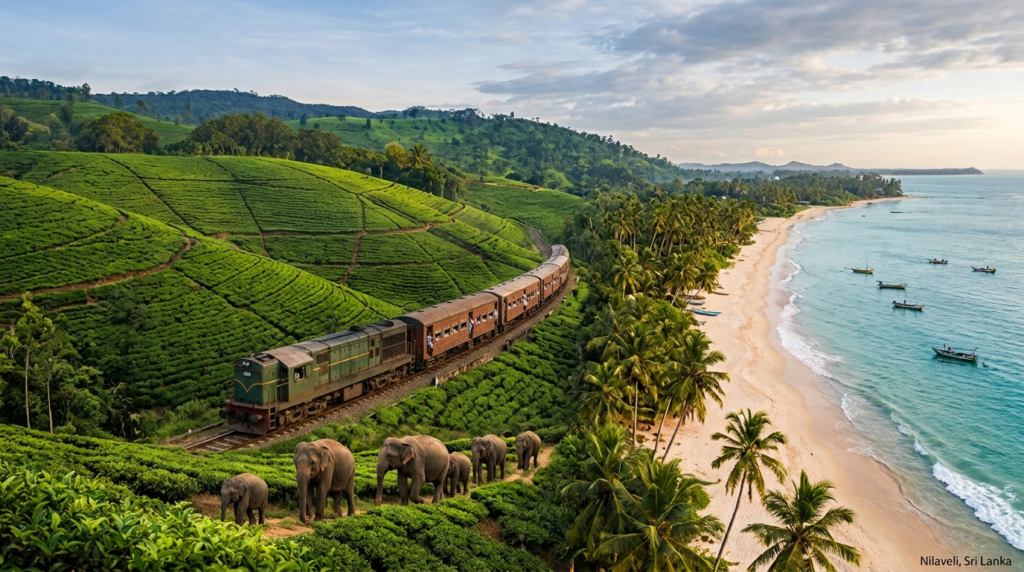
Sri Lanka is a small island with an extraordinary variety of experiences. Within a single holiday, you can climb an ancient rock fortress, explore historic temples, travel through misty tea plantations, ride one of Asia’s most scenic trains, spot elephants in the wild and finish your trip relaxing on a tropical beach.
But planning the perfect route can be tricky. Distances may look short on a map, yet mountain roads, traffic and local transport can make journeys longer than expected.
That’s why this 14-day Sri Lanka itinerary focuses on a practical route that combines the country’s best-known attractions with enough time to enjoy each destination.
Whether you’re travelling from the UK for your first Sri Lankan holiday, planning a couple’s adventure or organising a family trip, this guide will help you make the most of two weeks on the island.
Your 14-Day Sri Lanka Itinerary at a Glance
This route combines ancient history, culture, mountains, wildlife and beaches, with the south coast featured in the final part of the trip.
| Day | Destination | Highlights |
|---|---|---|
| Day 1 | Negombo | Arrival and recovery |
| Day 2 | Sigiriya | Travel to the Cultural Triangle |
| Day 3 | Sigiriya | Sigiriya Rock Fortress and Dambulla |
| Day 4 | Kandy | Temple of the Tooth and Kandy Lake |
| Day 5 | Nuwara Eliya | Tea country and hill-country scenery |
| Day 6 | Ella | Scenic train journey |
| Day 7 | Ella | Nine Arch Bridge and Little Adam’s Peak |
| Day 8 | Yala | Travel to wildlife country |
| Day 9 | Yala / Udawalawe | Wildlife safari |
| Day 10 | Mirissa / Weligama | Travel to the south coast |
| Day 11 | Mirissa / Weligama | Beaches and coastal activities |
| Day 12 | Galle | Galle Fort and the southern coast |
| Day 13 | Colombo | City sightseeing and food |
| Day 14 | Departure | Transfer to the airport |
Recommended duration: 13 nights and 14 days.
This itinerary is designed primarily for travel between November and April, when the south and west coasts generally offer more favourable beach conditions. If you’re visiting during other months, you can adjust the coastal section to suit the seasonal weather.
Day 1: Arrive in Sri Lanka and Relax in Negombo
Your Sri Lankan adventure begins at Bandaranaike International Airport, near Colombo.
After a long international flight, resist the temptation to start sightseeing immediately. Give yourself time to arrive, collect your luggage, arrange transport and settle into your hotel.
For your first night, consider staying in Negombo, a coastal town close to the airport.
What to do in Negombo
Depending on your arrival time, you could:
- Take a relaxing walk along Negombo Beach.
- Explore the town’s fishing culture.
- Visit a local restaurant for your first Sri Lankan rice and curry.
- Enjoy a sunset by the sea.
- Rest before starting your journey inland.
Negombo is not essential if you arrive early and prefer to travel directly towards Sigiriya. However, an overnight stay can make the first day much more comfortable after a long flight.
Overnight: Negombo.
Day 2: Travel to Sigiriya and Explore the Cultural Triangle
Today, head inland towards Sigiriya, one of Sri Lanka’s most famous historical destinations.
The drive takes several hours, depending on your starting point, traffic and stops along the way.
The Cultural Triangle contains ancient cities, Buddhist monuments, archaeological sites and important religious landmarks. It is one of the best areas in Sri Lanka for understanding the island’s history.
What to do
Keep the day flexible. After arriving at your accommodation, you could:
- Relax at your hotel.
- Visit a nearby village.
- Explore the surrounding countryside.
- Enjoy a traditional Sri Lankan meal.
- Arrange transport for the following morning’s sightseeing.
If you arrive early enough, you might visit Dambulla or another nearby attraction. Avoid packing too much into the day if you’re tired from travelling.
Where to stay
Sigiriya is convenient for visiting the rock fortress early the next morning. Habarana and Dambulla are also useful bases for exploring the region.
Overnight: Sigiriya or Habarana.
Day 3: Climb Sigiriya Rock Fortress and Visit Dambulla
Today is one of the highlights of your trip.
Morning: Sigiriya Rock Fortress
Start early and visit Sigiriya Rock Fortress, a remarkable ancient site rising dramatically above the surrounding forests.
The site is famous for its enormous rock formation, landscaped gardens, archaeological remains and panoramic views.
The climb involves stairs and exposed sections, so wear comfortable footwear, carry water and allow enough time to explore at your own pace.
Early morning is usually preferable because temperatures can rise quickly.
If climbing the rock isn’t suitable for everyone in your group, you can still enjoy the surrounding landscape and gardens, subject to site access and ticket arrangements.
Afternoon: Dambulla Cave Temple
After lunch and a break, visit Dambulla Cave Temple, a historic Buddhist temple complex known for its cave shrines, statues and religious paintings.
Wear clothing that covers your shoulders and knees, and be prepared to remove your shoes where required.
Optional wildlife experience
The Cultural Triangle is also known for wild elephants. If you would like to see them, consider a responsible safari in a suitable nearby wildlife area.
Elephant sightings and seasonal gathering locations vary, so ask a reputable local operator about current conditions rather than assuming a particular park will always provide the best viewing.
Overnight: Sigiriya or Habarana.
Day 4: Sigiriya to Kandy
After breakfast, travel to Kandy, a city surrounded by green hills and centred around a picturesque lake.
Kandy is an important cultural destination and a useful stop between the Cultural Triangle and the central highlands.
Visit the Temple of the Tooth
The Temple of the Tooth, or Sri Dalada Maligawa, is one of the most significant Buddhist religious sites in Sri Lanka.
The temple is associated with a sacred tooth relic of the Buddha and attracts both pilgrims and visitors.
Dress respectfully, follow the site’s instructions and be considerate when taking photographs.
Walk around Kandy Lake
Kandy Lake offers a pleasant place for a walk, particularly in the late afternoon.
You can also explore nearby shops, cafés and local markets.
If you have time, consider a visit to the Royal Botanic Gardens at Peradeniya, just outside the city. It is particularly appealing to travellers interested in tropical plants and landscaped gardens.
You do not need to fit every attraction into one afternoon. Kandy is worth enjoying at a relaxed pace.
Overnight: Kandy.
Day 5: Kandy to Nuwara Eliya — Tea Country and Mountain Scenery
Today, travel deeper into Sri Lanka’s hill country towards Nuwara Eliya.
The scenery changes as you climb into the central highlands. You will see tea-covered slopes, winding roads, waterfalls and cooler mountain air.
Nuwara Eliya is known for its tea plantations, colonial-era architecture, gardens and cool climate.
What to do along the way
Depending on your route and available time, you could:
- Stop at a tea plantation.
- Visit a tea factory that welcomes visitors.
- Learn how Ceylon tea is processed.
- Photograph mountain scenery and waterfalls.
- Explore the town’s gardens and historic buildings.
Tea factory tours vary, and not every plantation offers public visits. Confirm opening arrangements before travelling to a particular factory.
Explore Nuwara Eliya
Once you arrive, take a walk around Gregory Lake or explore the town centre.
Bring a light jacket. Even when the lowlands are hot, the hill country can be noticeably cooler, especially in the evening.
Overnight: Nuwara Eliya.
Day 6: The Scenic Train Journey to Ella
This is one of the most anticipated days of a Sri Lankan holiday.
Travel from the Nuwara Eliya area towards Ella by train, using the station and connection that best suit your confirmed route.
Nanu Oya is the railway station commonly used for Nuwara Eliya, while Ella is a popular destination farther along the hill-country railway.
The journey offers views of:
- Tea plantations.
- Forest-covered mountains.
- Deep valleys.
- Small villages.
- Waterfalls and misty hills.
The landscape changes throughout the journey, making the train ride an attraction in its own right.
Book train seats in advance
The scenic railway is popular, especially during busy travel periods.
Sri Lanka Railways operates an official advance seat-reservation service for eligible trains. Check the route, date, train and available classes before booking.
Official reservation website: https://seatreservation.railway.gov.lk/
Train schedules, seat availability and journey times can change. Avoid building your entire day around an unconfirmed departure.
Arriving in Ella
After reaching Ella, check into your accommodation and enjoy the town’s relaxed atmosphere.
You’ll find cafés, restaurants, small shops and mountain views.
Overnight: Ella.
Day 7: Discover Ella, Nine Arch Bridge and Little Adam’s Peak
Ella is one of the best places in Sri Lanka to slow down and enjoy the natural landscape.
You have a full day here, so there’s no need to rush.
Visit Nine Arch Bridge
Nine Arch Bridge is a famous railway bridge surrounded by lush vegetation.
Its stone arches and green surroundings make it one of the country’s most photographed landmarks.
If you want to see a train crossing the bridge, check the latest train information locally and allow for delays. Stay in permitted viewing areas and never stand on railway tracks for photographs.
Hike Little Adam’s Peak
Little Adam’s Peak is a popular hike offering panoramic views of the surrounding hills.
The route is generally more accessible than the challenging climb to Ella Rock, although the terrain and steps may still be difficult for some visitors.
Start early to avoid the hottest part of the day and bring drinking water.
Other things to do
If you prefer a slower day, consider:
- Visiting a tea plantation.
- Exploring Ravana Falls.
- Enjoying a local cooking class.
- Trying Sri Lankan tea and snacks at a café.
- Taking photographs of the surrounding hills.
Choose two or three activities rather than trying to fit everything in.
Overnight: Ella.
Day 8: Ella to Yala National Park
Leave the hill country and travel towards Yala, one of Sri Lanka’s best-known wildlife destinations.
As you descend from the mountains, the scenery becomes warmer and drier.
Yala is famous for its wildlife, including leopards, elephants, sloth bears, crocodiles, deer and a wide variety of birds.
Plan your arrival
Depending on your departure time from Ella and the safari schedule, you may be able to arrange an afternoon safari.
Alternatively, arrive, check into your accommodation and prepare for an early safari the following morning.
This is often the better choice if you want to avoid rushing.
Where to stay
Many visitors stay around Tissamaharama, Kataragama or accommodation near the park’s entrance that suits their planned safari.
Check the exact location of your lodge before booking, as the region is spread out.
Overnight: Yala area.
Day 9: Wildlife Safari — Yala or Udawalawe
Today is your chance to experience Sri Lanka’s wildlife.
You can choose between Yala and Udawalawe, depending on your interests and the route you want to follow.
Option 1: Yala National Park
Yala is known for its varied wildlife and is particularly famous for leopard sightings.
However, leopards are wild animals, and sightings are never guaranteed. The experience can still be rewarding when you see elephants, birds, crocodiles and other wildlife.
Option 2: Udawalawe National Park
Udawalawe is especially well known for elephants and open landscapes.
It can be an excellent choice if observing elephants is a priority for your trip.
Which should you choose?
If you are already staying near Yala, visiting Yala is the simplest option.
If elephants are your main interest, consider whether Udawalawe fits your route and travel time better.
For either park, choose a responsible safari operator. Avoid vehicles that crowd animals, chase wildlife or encourage unsafe interactions.
After the safari, relax at your accommodation before continuing to the coast the next day.
Overnight: Yala area.
Day 10: Yala to Mirissa or Weligama
Today, head towards Sri Lanka’s southern coast.
After several days of sightseeing and travelling through the mountains, the beach offers a welcome change of pace.
Choose Mirissa or Weligama as your base.
Mirissa
Mirissa is known for its sandy beach, palm-fringed coastline, restaurants and relaxed holiday atmosphere.
It is a popular base for visitors who want to combine beach time with coastal excursions.
Weligama
Weligama has a long sandy bay and is well known for beginner-friendly surfing conditions when the waves are suitable.
Surf schools and board rentals are available in the area, although conditions depend on the season and weather.
Which is better?
Choose Mirissa if you prefer a beach destination with a lively holiday atmosphere.
Choose Weligama if surfing and a larger bay appeal to you.
Both can work well for exploring nearby parts of the south coast.
Overnight: Mirissa or Weligama.
Day 11: Enjoy the Southern Beaches
After a busy journey around the island, leave today largely unplanned.
You could spend the morning on the beach, try surfing, visit a nearby coastal village or enjoy a long lunch overlooking the sea.
Whale watching in Mirissa
Mirissa is a well-known departure point for whale-watching excursions during the season.
Sightings are never guaranteed, and conditions at sea can change. Choose an operator that follows responsible wildlife-viewing practices and gives marine animals appropriate space.
If you are prone to seasickness, consider your comfort before booking a boat trip.
Explore nearby beaches
Depending on your base and transport, you could also explore:
- Dalawella.
- Unawatuna.
- Weligama.
- Nearby coastal viewpoints.
Avoid turning this into a full day of driving. One or two places are enough.
Overnight: Mirissa or Weligama.
Day 12: Galle Fort and the Southern Coast
Travel towards Galle and spend the day exploring one of Sri Lanka’s most atmospheric historic destinations.
Explore Galle Fort
Galle Fort is a historic fortified town recognised for its cultural and architectural significance.
Walk through its narrow streets and discover colonial-era buildings, churches, cafés, boutiques and small galleries.
The fort’s ramparts are especially popular in the late afternoon, when visitors gather to enjoy views over the Indian Ocean.
What to do in Galle
Allow time to:
- Walk along the fort walls.
- Explore the old streets.
- Visit small shops and galleries.
- Stop for coffee or lunch.
- Photograph historic buildings.
- Enjoy the sunset by the sea.
You can visit Galle as a day trip from Mirissa or Weligama, or stay overnight if you prefer a slower pace.
For this itinerary, you can either spend the night in Galle or continue towards Colombo the following day.
Overnight: Galle or nearby.
Day 13: Travel to Colombo and Explore the City
Today, make your way towards Colombo.
Sri Lanka’s commercial capital offers a different experience from the ancient sites, mountain towns and beaches you’ve visited.
If you arrive early enough, explore some of the city’s main attractions.
Galle Face Green
Galle Face Green is a seafront open space where people gather to walk, relax and enjoy the evening atmosphere.
It is also a popular place to try local street food.
Gangaramaya Temple
Gangaramaya is a well-known Buddhist temple complex in Colombo.
Dress respectfully and follow local instructions when visiting.
Pettah Market
Pettah offers a busy shopping district with markets and streets selling a wide variety of goods.
It can be crowded, so keep an eye on your belongings and allow time to explore without rushing.
Try more Sri Lankan food
If you haven’t already, try:
- Kottu roti.
- Hoppers.
- String hoppers.
- Rice and curry.
- Pol sambol.
- Sri Lankan tea.
You could also enjoy a final dinner at a restaurant serving traditional Sri Lankan cuisine.
Overnight: Colombo or near the airport.
Day 14: Departure from Sri Lanka
Your final day depends on your international flight time.
If you have an early flight, arrange transport well in advance and travel directly to Bandaranaike International Airport.
If your flight leaves later, you may have time for breakfast or a little last-minute shopping.
Allow plenty of time for the airport journey, particularly if you are travelling from Colombo during busy traffic periods.
Avoid planning a major sightseeing trip immediately before departure.
Your two-week Sri Lankan adventure may be ending, but you should be leaving with memories of ancient monuments, tea-covered mountains, scenic railway journeys, wildlife and tropical beaches.
How Much Does a 14-Day Trip to Sri Lanka Cost?
The cost of two weeks in Sri Lanka depends on your accommodation, transport, activities, travel season and whether you travel independently or hire a private driver.
Your main expenses will usually include:
- International flights.
- Accommodation.
- Transport between destinations.
- Food and drinks.
- Attraction entrance fees.
- Safari excursions.
- Train reservations.
- Travel insurance.
- Shopping and other personal expenses.
Budget travel
Travellers using guesthouses, local restaurants and public transport can often keep costs lower.
However, allow extra money for major attractions, long-distance transport and activities you consider essential.
Mid-range travel
A mid-range holiday might combine comfortable hotels, a mixture of local and international restaurants, a scenic train journey and selected private transfers.
For couples and families, a private driver can be worth considering because it makes multi-stop travel easier.
Luxury travel
Luxury travellers can choose boutique hotels, high-end resorts, private guides and tailored wildlife experiences.
Accommodation and safari choices can make a substantial difference to the total cost.
Planning tip: Prepare your budget around the experiences you want, not just the number of days. A holiday with several safaris, guided excursions and luxury beach stays will cost more than one focused on hiking, local food and guesthouses.
How Should You Travel Around Sri Lanka?
For a two-week itinerary, combining private transport with the scenic train is often a practical option.
Private driver
A private driver offers flexibility for destinations such as Sigiriya, Kandy, Nuwara Eliya, Ella, Yala and the south coast.
You can stop for photographs, visit attractions along the way and avoid managing luggage on multiple public transport connections.
Agree on the itinerary, inclusions, overnight arrangements and any additional charges before booking.
Train
The hill-country train is one of Sri Lanka’s signature travel experiences.
It is particularly worthwhile for the scenic section towards Ella, but check the route carefully and reserve seats where available.
Official website: https://seatreservation.railway.gov.lk/
Buses and local transport
Buses, tuk-tuks and local taxis can be useful for shorter journeys.
They are often cheaper than hiring a private vehicle, but may require more planning and flexibility.
Is a private driver worth it?
For first-time visitors travelling as a couple, family or small group, a private driver can simplify a multi-destination trip.
If you’re travelling solo on a tight budget, public transport and occasional taxis may be a better fit.
Best Time to Visit Sri Lanka for This 14-Day Itinerary
Sri Lanka can be visited throughout the year, but the best route depends on the season.
The island experiences different rainfall patterns across its regions, so the south coast, east coast and hill country do not always have the same conditions.
November to April
This is generally a favourable period for the south and west coasts, including Mirissa, Weligama, Galle and nearby beach destinations.
The Cultural Triangle and hill country can also be included, although local weather varies.
May to September
During these months, the southwest monsoon can bring wetter conditions to the south and west coasts and parts of the hill country.
The east coast, including Trincomalee and Nilaveli, often becomes a more attractive beach option.
If you’re travelling during July or August, consider replacing some of the southern beach days with time on the east coast.
October and November
These months can bring less predictable weather across multiple regions.
You can still travel, but keep your plans flexible, check local forecasts and avoid assuming every beach will have calm swimming conditions.
For more detail, read our guide: Best Time to Visit Sri Lanka: Complete Month-by-Month Guide.
Alternative: A 14-Day Sri Lanka Itinerary for July and August
If you’re travelling during the UK summer holidays, you may want to adjust the route to include more of the east coast.
Here is one alternative:
| Day | Destination | Main activity |
|---|---|---|
| Day 1 | Negombo | Arrival and rest |
| Day 2 | Sigiriya | Travel inland |
| Day 3 | Sigiriya | Rock Fortress and Dambulla |
| Day 4 | Kandy | Temple and cultural attractions |
| Day 5 | Nuwara Eliya | Tea country |
| Day 6 | Ella | Scenic train journey |
| Day 7 | Ella | Hiking and Nine Arch Bridge |
| Day 8 | Trincomalee | Travel to the east coast |
| Day 9 | Nilaveli | Beach time |
| Day 10 | Trincomalee | Coastal activities |
| Day 11 | Trincomalee | Relax or explore nearby sites |
| Day 12 | Cultural Triangle | Return inland |
| Day 13 | Colombo / Negombo | Travel towards the airport |
| Day 14 | Departure | Airport transfer |
This version gives you more time on the east coast, where conditions are often better during the middle of the year.
It also avoids relying on the southern beaches for the entire beach portion of your holiday.
Always check current weather and sea conditions before swimming, snorkelling or booking boat trips.
What Should You Pack for Two Weeks in Sri Lanka?
Sri Lanka is generally warm, but temperatures vary considerably between the coast and the central highlands.
Pack lightweight clothing for the lowlands and something warmer for the hill country.
Useful items include:
- Comfortable walking shoes.
- Lightweight clothes.
- Sandals.
- Swimwear.
- Sun hat and sunglasses.
- Sunscreen.
- Insect repellent.
- Reusable water bottle.
- Small daypack.
- Power bank and travel adapter.
- Light rain jacket.
- A warmer layer for Ella and Nuwara Eliya.
- Clothing that covers shoulders and knees for religious sites.
A small daypack is especially useful for hikes, train journeys and day trips.
You do not need to pack a different outfit for every activity. Lightweight clothing that can be washed and reused makes travel easier.
Important Tips for First-Time Visitors
1. Don’t underestimate journey times
Sri Lanka may look small, but travel can be slower than expected, particularly in the mountains and around busy towns.
Leave room in your schedule for delays.
2. Book popular train seats early
The scenic railway is popular, and reserved seats can be limited on particular services.
Check official reservation options before travelling.
3. Respect local religious customs
Dress modestly at temples, remove footwear where required and follow instructions about photography.
4. Choose responsible wildlife experiences
Avoid operators who chase animals or encourage unsafe interactions.
Wildlife sightings are never guaranteed, and animals should be allowed to behave naturally.
5. Don’t try to visit every attraction
Two weeks gives you a good amount of time, but it is still worth leaving some afternoons free.
A slower trip is often more memorable than one filled with constant transfers.
6. Check entry requirements before travelling
Visa and entry requirements can change. Check the latest official Sri Lankan immigration guidance for your nationality before departure.
UK travellers should also check their passport validity and travel insurance arrangements.
7. Keep some flexibility in your itinerary
Weather, transport schedules and local conditions can change.
A flexible plan makes it easier to adapt without losing the enjoyment of your holiday.
Frequently Asked Questions
Is 14 days enough to explore Sri Lanka?
Yes. Two weeks is enough to experience several of Sri Lanka’s major highlights, including the Cultural Triangle, Kandy, the hill country, Ella, wildlife and the southern coast.
You will not see every part of the island, but you can enjoy a varied and rewarding first trip.
What is the best route for two weeks in Sri Lanka?
A popular first-time route is Negombo, Sigiriya, Kandy, Nuwara Eliya, Ella, Yala, the southern coast and Colombo.
The route combines history, scenery, wildlife and beaches without requiring you to travel to every corner of the country.
Should I hire a driver for two weeks?
A private driver is a convenient option for multi-stop travel, especially if you’re travelling as a couple, family or small group.
Budget-conscious travellers can combine trains, buses, tuk-tuks and taxis instead.
Can I visit Sri Lanka without a private driver?
Absolutely. Sri Lanka has trains, buses, taxis and tuk-tuks. Public transport can be a rewarding way to travel, although it may take more time and planning.
Is Sri Lanka suitable for families?
Yes, many families enjoy Sri Lanka’s beaches, wildlife, cultural attractions and scenic landscapes.
For families with young children, reduce the number of hotel changes and avoid scheduling long drives on consecutive days whenever possible.
Is this itinerary suitable for couples?
Yes. The combination of mountains, tea plantations, wildlife and beaches makes it suitable for couples who want a mix of adventure and relaxation.
You can also adapt it for a honeymoon by choosing more boutique accommodation and allowing extra time at the coast.
Should I visit Yala or Udawalawe?
Yala is famous for leopards and varied wildlife, while Udawalawe is particularly well known for elephants.
Your choice should depend on your interests, current park conditions and the route you plan to follow.
Can I see Sri Lanka in two weeks on a budget?
Yes. Use guesthouses, local restaurants and public transport where practical, and prioritise the attractions that matter most to you.
Major entrance fees, private safaris and some transport options can increase the total cost, so plan for them in advance.
What if I have 15 or 16 days?
Use the extra time to slow down rather than automatically adding another destination.
You could spend longer in Ella, add another beach day, explore Polonnaruwa or Anuradhapura, or include Trincomalee when the east coast is in season.
Final Thoughts: Two Weeks in Sri Lanka
Two weeks in Sri Lanka gives you the opportunity to experience an extraordinary variety of landscapes and cultures.
You can climb Sigiriya Rock Fortress, explore the Temple of the Tooth in Kandy, watch tea-covered hills roll past your train window, discover Ella’s mountain trails, look for elephants on safari and watch the sun set over the Indian Ocean.
The secret to a successful trip is balancing sightseeing with time to enjoy each place.
Don’t spend your entire holiday rushing from one hotel to another. Choose a route that suits the season, allow enough time for travel and leave space for the unexpected experiences that make a holiday memorable.
From ancient kingdoms to misty mountains and tropical beaches, 14 days in Sri Lanka can be the beginning of a lifelong love of the island.
And if you find yourself wishing you had more time, don’t worry. Sri Lanka is a destination that always leaves something for your next visit.
Leave a Reply